
Study Abroad in Poznan, Poland Info Session, Nov. 2nd
Dear Students,
Please come to an information session on Nov. 2 at 6 pm in 210 Dabney Hall to learn more about the site and courses of our Study Abroad program for Science, Math and Engineering majors. This program is being offered at a cost, which is equivalent to tuition, room and board at NCSU. It will run from early August to November, 2017 in Poznan, Poland. Poznan is a beautiful city with a historic Old Market Square and Old Town. It is also modern in many ways with a newly built campus that has excellent facilities. This program is designed to reach as many majors as possible from Pre-professional to Engineering. Please come and see for yourselves.
Dr. Franzen
Interested in Marine Biology? Check out Semester@CMAST.
Course List for Semester@CMAST
Spring Semester, 2017
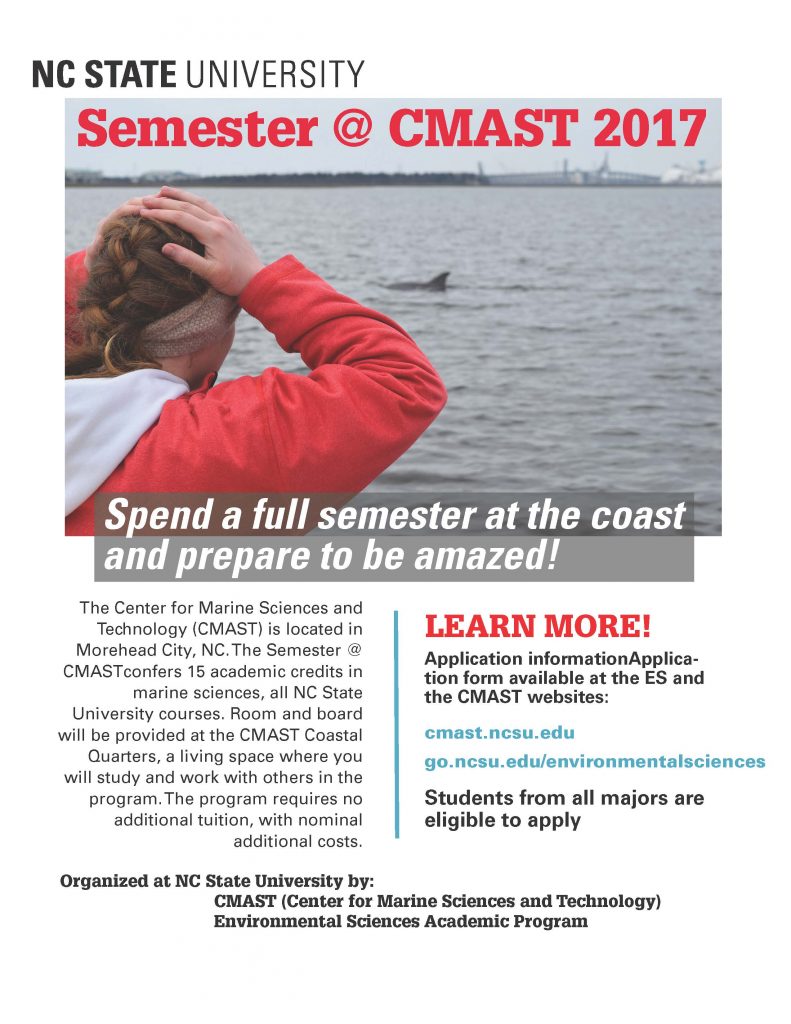
The Semester@CMAST Program is offering a full semester of undergraduate, academic programming for up to 20 students at the Center for Marine Sciences and Technology (CMAST). CMAST is the University’s coastal academic and research facility located in Morehead City. A flier for the S@C Program is attached.
The S@C Program is a special opportunity for undergraduate students to spend a full semester living and learning at the coast. This University Program, supported by the Provost and Deans, welcomes applicants from all colleges, and classes ranging from freshman to seniors. Students pay normal University tuition and fees, and financial aid and health care programs currently in place will continue to apply. Students will live in newly remodeled housing, Coastal Quarters, located close to CMAST Coastal Quarters provides shared or single living arrangements, cooking facilities, and is managed by University Housing.
Students should apply by November 1 using the simple one-page application attached to this message. We welcome questions, and provide a list of courses available to students, below. Thank you for your help in recruiting students.
Dr. David Eggleston
Director, CMAST
Dr. William Winner
Director, Environmental Sciences Academic Program
MEA 200, Oceanography (3 Cr)MEA 493-2, Marine Conservation Biology (3 Cr)ES 295-1, Biology of Marine Mammals (3 Cr)AEC 295-1, Marine Fisheries (3 Cr)ES 295-2, Marine Resource Management and Policy (3 Cr)ES 496, Internship (1-3 Cr)ES 498, Research (1-3 Cr)Other Research and Internship Courses as Advised (CR TBA)
Social Entrepreneurship Competitions
|
Social Entrepreneurship Challenges
Info Sessions: Tuesday, October 25th @ 5:00pm – Talley RM 4140
Wednesday, October 26th @ 4:30pm – Talley RM 4270
Monday, October 31st @ 5:30pm – Talley RM 3285
|
|
The Center for Student Leadership, Ethics and Public Service (CSLEPS) are inviting passionate students committed to addressing social issues using creative and innovation solutions to attend one of the Social Entrepreneurship Challenges Information Session.
The session will discuss two separate programs for pitching ideas that provide a unique solution to emerging social issues. Whether you, or a team of students, have written a blueprint for social change or have a general interest, this information session will showcase ways to use your passion to collaborate and design solutions to real world problems and how to navigate the application process for these programs.
Social Entrepreneurship Challenges Info Sessions: Attendance is strongly encouraged but more information will be posted on the CSLEPS website after the information sessions.
|
|


|

|

“A conversation with Dr. Paul Ehrlich: The Sixth Mass Extinction is Here.”
When: Wednesday, October 19, 7:00 p.m.-8:30 p.m.
Where: James B. Hunt Jr. Library Auditorium
| The end of the world as we know it Dr. Paul Ehrlich, environmental futurist pioneer, talks about humanity’s growing footprint on the planet |
|
It sounds obvious when you say it—growing populations require more and more resources to survive. Dr. Paul Ehrlich, founder of the field of coevolution and author of the prescient 1968 classic The Population Bomb, has made a career of saying it until people finally began to listen and change public policy.
The free, public talk is co-presented by the NCSU Libraries, NC State’s College of Sciences (Department of Biological Sciences), College of Agriculture and Life Sciences (Department of Applied Ecology), the Southeast Climate Science Center, and the Global Environmental Change Cluster. Through his tireless research, Dr. Ehrlich has raised issues of population, resources, and the environment as matters of public policy. Co-founder, with Peter H. Raven. of the field of coevolution, Ehrlich has pursued long-term studies of the structure, dynamics, and genetics of natural butterfly populations. His research interests cover several areas including the ways that human-disturbed landscapes can be made more hospitable to diversity. “For five decades, beginning with the provocative and controversial book, The Population Bomb, Paul Ehrlich has focused public attention on human population growth,” says Dr. Nick M. Haddad, an NC State applied ecology professor. “Among Ehrlich’s 43 books, he has revealed the consequences of the growing footprint of humans for the natural world. His scientific contributions and impacts are broad, and include acclaimed advances in the biology of everything from butterflies and evolution.” Dr. Ehrlich is Bing Professor of Population Studies and Professor of Biological Sciences at Stanford University. He has been elected a member of the National Academy of Sciences and has won many honors, including the Crafoord Prize, an explicit substitute for the Nobel Prize in fields of science where the latter is not given; the John Muir Award from the Sierra Club; the Gold Medal Award from the World Wildlife Fund International; a MacArthur Prize Fellowship; the United Nations’ Sasakawa Environment Prize; the Heinz Award in the Environment; and the Heineken Prize for Environmental Sciences. Contact: |